

At a recent industry dinner, I found myself seated next to John, a family law principal with his own firm. Naturally, I asked how business was going, and if he was hiring, hoping to find out if Insource’s talent database could support his firm.
His response caught me completely off guard.
“I’m actually in the process of closing the practice,”
Asking him what happened, he explained that his two senior associates had resigned within weeks of each other, both heading to other firms. After years of stress, two global financial crisis’s, and recent health issues, those two departures were the final straw for John. He’d decided to shut up shop.
Retention, Attrition, and the Tipping Point
Retention and attrition are natural forces in any profession. But in family law—where firms are often small and built on tight-knit teams, complementary skill sets, and deeply held relationships—the departure of key staff can feel like a gut punch. Losing multiple senior staff in quick succession can be a knockout blow.
Family law practitioners are particularly mobile, with a strong demand in the market and less barriers to launching your own practice than fields like Personal Injury, both junior and senior staff are liable to change roles at any moment.
When this happens, they don’t just take billable hours—they take client relationships, expertise, goodwill, and stability. And in today’s tight market, replacing them is no easy feat.
As I talked with John over dinner, he walked me through his decision to close his firm.
“My wife actually works in a recruitment firm,” he told me. “When the first Senior Associate resigned, I started talking with her about how we might replace them. But based on what she was telling me over the kitchen table each night, I knew it would be tough.”
John proceeded to tell me anecdotes of his wife advertising roles and getting no qualified applicants. Head-hunting was proving just as difficult even with their “black book” and trying to map the market for each role takes time, and even then, you’re not sure if the candidates are the right fit.
“When the second Senior Associate resigned,” he said, “I realised I’d have to pull a rabbit out of the hat—twice. And probably pay a recruiter for it both times, with where the firm was at the idea of having to work longer to pay off that investment hiring new staff didn’t make sense”
The difficulty of hiring and retaining staff in the current market
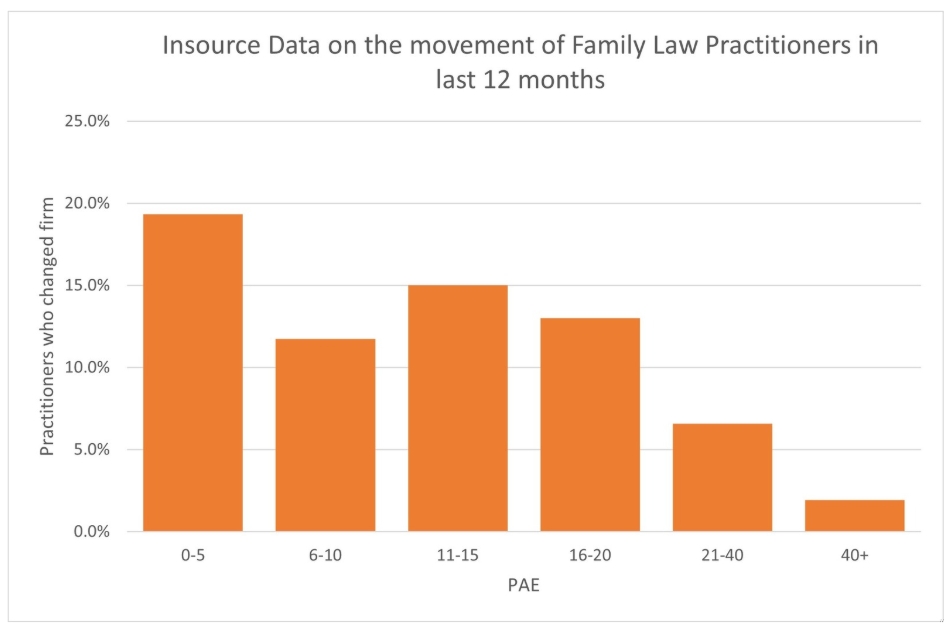
At Insource, we’ve watched this instability play out firsthand, tracking the comings and goings of staff from firms nationally. In the past 12 months, nearly 1 in 5 family lawyers with 0–5 years’ experience changed roles.
While that might sound like a buoyant market, the reality is that 4 in 5 lawyers stayed put. Meaning that most firms are fishing from the same limited pool of talent, spurring multiple recruitment agencies to set up satellite offices in New Zealand in order to find more candidates.
This tension is echoed across the broader legal sector. Surveys by Actionstep and ALPMA show that recruitment and retention remain the top HR challenges for mid-sized law firms and member firms respectively, citing that 60% of firms expect hiring to remain difficult through 2025 and into 2026 and one of their largest strategic challenges.
The Hidden Cost of the Waiting Game
When firms wait until a staff member resigns before they start thinking about their replacement the consequences can be severe. The average hiring process via job ad takes approximately 6–8 weeks to reach the offer stage. If your offer is accepted immediately with no counteroffer or drama, you’ll then have to wait at least another 4 weeks while your new hire serves their notice before they able to start.
At best, that’s almost three months of lost productivity—assuming someone qualified applies to your initial job ad and you don’t have to start from scratch and readvertise.
While all this is playing out, the workload of your departed solicitor doesn’t disappear. It’s absorbed by remaining staff, leading to stress, burnout, reduced service quality, and sometimes, even more resignations unless you’re able to fill the gap left in your team.
Waiting until you have a need before starting your search puts pressure on the business with the imminent departure of your tenured employee putting a ticking clock on the recruitment process and bringing you ever closer to being understaffed.
Going to market in the heat of the moment, means you only connect with or attract people who are looking at the same time as you.
You’re not getting the best of the market, you’re not getting the whole of the market, you’re getting a snapshot, a handful of professionals who are looking at a job board at any one point in time, specifically those looking to leave their current job in the immediate future.


The High Cost of Outsourcing Recruitment
Faced with the prospect of job ads not securing a candidate, many firms turn to recruiters to supplement their search, knowing that “I’ll only pay if I actually take their candidate”.
It’s not uncommon to see fees equivalent to the cost of a new family car. 20% or more of starting salary, meaning $20K–$30K per placement for early career hires, or significantly more for senior hires.
But unlike a new car the warranties for these new hires are less reliable, often with short windows for performance guarantees and other hidden intangible costs, like an increased dependence on using recruiters in the long run, a limited view of the market and potential candidates responses to your role or firm, and a lack of control over how your brand is being portrayed to prospective candidates.
There’s a Better Way
Imagine if the next time you have someone resign from your firm you already have their replacement waiting in the wings. No dramatic loss of productivity or billables, no additional stress being pushed on to your team, no nights spent wondering how to fill a looming hole in your firm.
Through proactive recruitment, its entirely is possible—and the impact is powerful.
Just like for good business development, it pays to be thinking ahead when it comes to recruitment. Directly approaching candidates with recruitment propositions can feel awkward and uncomfortable for both parties, but when its a quiet undercurrent in your conversations, there is space for the idea of joining your firm to mature into a meaningful proposition, backed by your EVP rather than a bigger bag of money. Time and again Insource has seen success from firms who have their Partners and Directors close to their recruitment, taking an active hand in having coffee with prospective hires and building a warm pipeline of practitioners who might make the decision to join their practice in the future when the time is right.
Family law firms that play to their strengths, utilising agility and strong networks, are well-positioned to transition to this proactive approach. Firms that are thriving aren’t just reacting to the cards they’re dealt—they’re planning ahead and building relationships with future candidates now, before they have a hiring need and before the candidate is actively applying for other jobs.
Tools That Make It Easier
Traditionally, recruiters kept a literal “black book” of potential candidates. It took time, effort, and constant updates, to keep these lists viable and to allow them to stay in business. As technology has advanced, so too have their tools but the time consuming search process remains, working to identify candidates based on a firms needs.
This is where tools like Insource’s database can help firms get an edge over their competition and recruiters in the market. Firms can now access a real-time, searchable database of every registered lawyer in Australia and New Zealand, filterable by practice area, geography, seniority, or firm history, enabling market maps to be created in seconds, longlists to be built in minutes and targeted shortlists of candidates to approach to be finalised in half an hour, (or over your lunch break), ready for firms to reach out directly to prospective hires.
We’ve seen it firsthand: firms that plan ahead make better hires, reduce costs, and stay resilient—even when the unexpected happens.
Call It Succession Planning
Proactive recruitment might sound foreign, but call it succession planning, and it can start to feel more familiar.
Most firms claim they have succession plans, but when asked how they plan to fill key roles with external hires, that plan often includes a few gaps or the hope to snare an applicant via a traditional recruitment campaign.
Succession planning isn’t just for partners. It applies to every role in your firm. When you know who’s out there, build a shortlist in advance, and hire on your terms—not out of desperation—you help your firm move from reactive to resilient.
Strong Firms Plan for the Future
Back to John, and his decision to close his firm. Fortunately, his story ends on a happy note—as he now runs a charming wedding venue from his idyllic rural property with all his tech needs safely outsourced to his niece and her social media skills.
When it came to his firm, perhaps John’s biggest mistake was failing to plan far enough ahead for his firm’s resourcing needs. He knew that traditional recruitment approaches were either going to be too slow or too expensive to sustain the firm but even having these conversations over the dinner table wasn’t enough for him to start to think ahead.
But this does not have to be the case. Let’s stop letting vacancies and recruitment costs dictate the future of firms and lets stop letting ordinary attrition become an existential threat.
If you want to explore what the shift from reactive to proactive workforce planning would look like for your firm feel free to get in touch or visit www.insourcerecruit.com to learn more about how Insourcing your search for talent can help make your firm stronger.