

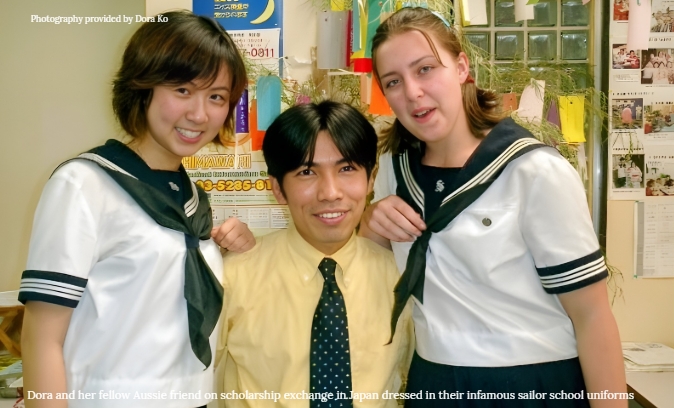
Eventually, a friend’s family took her in. “I’m forever indebted to them. They hadn’t planned to have a homestay, but they saw what was happening. That changed my entire overseas exchange experience for me.”
Choosing Law—With a Side of Psychology
Back in Australia, Dora enrolled in a double degree in law and psychology. “If I’m honest, my passion was probably more in psychology… but I didn’t want to follow what my parents wanted—health sciences. I had the marks for law, and I liked debating more than anything.”
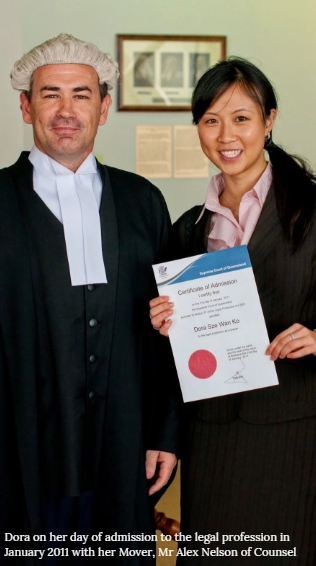
She got her start in a mid-tier Brisbane firm—first in the mail room, then as a participant in their clerkship program , where she discovered family law. “I was amazed watching Evette Clark, a senior associate. She was firm but kind, guiding clients through such difficult situations. I realised I am a people’s person. That’s what drew me in.”
From there came a traineeship which was a baptism of fire in legal aid work. “At one point I had 80 files as a first-year lawyer. It was sink or swim. I learned so much, but it wasn’t sustainable.”
She moved into a respected family law firm handling complex, high-net-worth, and international cases—including her first matter for a Chinese-speaking client, a jurisdictional dispute that went to trial. “I didn’t know what I was doing at first, but I was supported by great colleagues and barristers. That case opened my eyes to the value of being able to bridge legal and cultural worlds.”
When the police issued a protection notice and ousted her husband from the home, she wanted it withdrawn.
The second woman was in serious danger from a violent spouse but decided she wanted to withdraw her own application after speaking to the first woman in the waiting The second woman was in serious danger from a violent spouse but decided she wanted to withdraw her own application after speaking to the first woman in the waiting room. “That really highlighted to me how important it is that we try to help. I had to convince her that her situation was very different—that she needed protection. If I didn’t speak her language, if I didn’t understand the cultural lens, I might not have been able to get through to her.”
The Power of Cultural Context
Dora is quick to point out that cultural norms can influence everything from the instructions a client gives to how their case is perceived.
She recalls a Middle Eastern woman who came to her visibly injured. “She told me, ‘I will be disowning my family name… my father will have someone kill me if I did that.’ She wasn’t exaggerating. My usual advice—leave, safety plan, go to police—wasn’t workable. I had to think differently about how to keep her safe.”
In another case, a Chinese mother was accused of neglect because her seven-year-old’s teeth were decayed. “On the face of it, it looked bad. But the real reason was her parents—qualified Chinese medicine doctors—had told her to give honey water and vitamin C instead of plain water, believing it would boost immunity. It wasn’t about neglect—it was cultural practice. My job was to explain that to the court and show she was taking steps to address it.”
Even parenting arrangements can be misunderstood. “Our system prioritises time with both parents. But for some migrant families, sacrificing time and hard earned money to send children to tutoring or extracurriculars is seen as the best parenting—investing in their future. Without that lens, it’s easy for it to be painted as disinterest.”
Practical Cultural Competence
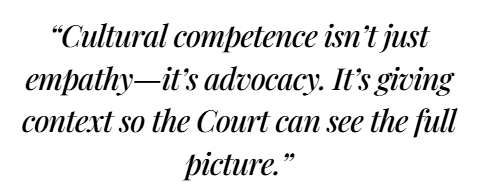
For Dora, cultural competence means more than empathy—it’s about advocacy. “If there are facts of a matter which may be peculiar or different to what one would normally expect,, make sure that is highlighted in the court material filed with sufficient context to assist the presiding judicial officer to give due consideration to those matters.”
She also believes mediation can be a better fit for culturally complex cases. “Court processes—and even the social science research they rely on—are often based on Western norms. In mediation, you can talk about values and priorities, and structure arrangements that reflect them.”
Facing Prejudice in the Profession
Throughout her career in family law, Dora has brought diversity to her role as an advocate—but it is not without challenges.
She recalls an incident from around nine years ago that she still remembers in vivid detail. The case was an urgent matter.
The court list was full, and by the afternoon it had become clear that another matter was going to take priority. Negotiations were tense; the other side’s barrister had been pressing their client’s position throughout the day.
Eventually, a compromise was reached for interim orders until the matter could be determined by the court on a further interim basis. It was then, in the liminal space outside the courtroom—an area where both clients and lawyers mingled—that the moment happened.
“He hadn’t really spoken to me all day,” she says. “We had counsel on both sides, so most of the exchanges were between the barristers. I was there, listening, taking notes. And then, out of nowhere, he waves a bit of paper of the draft interim orders, looks around, and says just loudly enough, ‘Where’s that little Chinese girl?’”
The words landed with a force that took her breath away. “It was loud enough for my client, his client, and everyone else to hear. It was so public. I froze. I didn’t know how to react.”
In the moment, she chose silence. She chose to act as though she did not hear the remark. But in reality, it lodged deep. “From then on, every time I went to court, I remembered it. It became a sort of background hum—a reminder that I was different.”
For Dora, the comment was professionally diminishing. “It’s not just about that one comment. It’s about how something like that stays with you, how it shapes your sense of belonging in a professional space.”
Despite those experiences, Dora continued to work to develop her skills as a family lawyer. Several years later, she was appointed to and worked at the very place where she was once made to feel very small – as a Judicial Registrar.