

Family violence is a significant issue with profound implications for individuals and families navigating the family law system. Under the Family Law Act 1975 (Cth), family violence is recognised as any violent, threatening, or coercive behaviour that controls or intimidates. (https://www.fcfcoa.gov.au/fl/fv/overview)
“FAMILY LAW ACT 1975 – SECT 4AB Definition of family violence etc.
FAMILY LAW ACT 1975 – SECT 4AB
Definition of family violence etc.
(1) For the purposes of this Act, family violence means violent, threatening or other behaviour by a person that coerces or controls a member of the person’s family (the family member ), or causes the family member to be fearful.
(2) Examples of behaviour that may constitute family violence include (but are not limited to):
(a) an assault; or
(b) a sexual assault or other sexually abusive behaviour; or
(c) stalking; or
(d) repeated derogatory taunts; or
(e) intentionally damaging or destroying property; or
(f) intentionally causing death or injury to an animal; or
(g) unreasonably denying the family member the financial autonomy that he or she would otherwise have had; or
(h) unreasonably withholding financial support needed to meet the reasonable living expenses of the family member, or his or her child, at a time when the family member is entirely or predominantly dependent on the person for financial support; or
(i) preventing the family member from making or keeping connections with his or her family, friends or culture; or
(j) unlawfully depriving the family member, or any member of the family member‘s family, of his or her liberty.
(3) For the purposes of this Act, a child is exposed to family violence if the child sees or hears family violence or otherwise experiences the effects of family violence.
(4) Examples of situations that may constitute a child being exposed to family violence include (but are not limited to) the child:
(a) overhearing threats of death or personal injury by a member of the child‘s family towards another member of the child‘s family; or
(b) seeing or hearing an assault of a member of the child‘s family by another member of the child‘s family; or
(c) comforting or providing assistance to a member of the child‘s family who has been assaulted by another member of the child‘s family; or
(d) cleaning up a site after a member of the child‘s family has intentionally damaged property of another member of the child‘s family; or
(e) being present when police or ambulance officers attend an incident involving the assault of a member of the child‘s family by another member of the child‘s family.”
Legal practitioners play a crucial role in ensuring the safety and well-being of victims, particularly children. By adhering to best practice principles, family lawyers can deliver compassionate, effective, and trauma-informed representation.
This blog outlines key principles and strategies for addressing family violence in family law matters.
As shown above, The Family Law Act 1975 defines family violence in Section 4AB as behaviour that coerces or controls a family member or causes them to be fearful. This includes physical, emotional, psychological, financial, and coercive behaviours.
The Act also prioritises the safety of children under Section 60CC, which outlines the best interests of the child as the paramount consideration in parenting matters.
Understanding and addressing family violence is critical in ensuring just outcomes for vulnerable individuals and families.
Key Best Practice Principles for Family Lawyers
1. Prioritise Safety
a. Assess the risk to clients and children early and throughout the case
b. Take proactive steps to ensure their safety, including applying for protection orders under relevant state or territory legislation and connecting them to Police, and appropriate resources and support including social works, psychologists, counsellors and other domestic violence agencies.
c. Use secure communication methods and protect confidential client information.
d. Ask your client to undertake a throughout audit of all of their electronic devises looking for malware and other programs tracking their whereabouts and to undertake a sweep of their property and vehicles of listening and tracking devices. The E-Safety Commissioner (https://www.esafety.gov.au/) has some excellent resources you can provide to your clients for this purpose.
2. Adopt a Trauma-Informed Approach
a. Recognise the effects of trauma on clients and their decision-making.
b. Avoid re-traumatisation by being mindful of questioning techniques and case strategies.
c. Create a safe and supportive environment for clients to share their experiences.
d. Read our detailed blogs here explain what trauma informed practice is and some strategies to apply it in your matters
3. Understand the Dynamics of Family Violence
a. Educate yourself about the various forms of family violence and their impact on victims.
b. Avoid minimising or dismissing non-physical forms of abuse, such as financial control or coercive behaviour.
4. Ensure Child-Centred Practices
a. Prioritise the best interests of children in parenting matters, as outlined in Section 60CC of the Family Law Act.
b. Understand how family violence affects children, even if they are not direct targets
c. Advocate for arrangements that prioritise the safety and well-being of children.
5. Work Collaboratively
a. Collaborate with social workers, psychologists, and other professionals to provide comprehensive support to clients
b. Refer clients to specialist family violence services for additional assistance. Click Here for a list of DV services
6. Cultural Competence
a. Be aware of how cultural, linguistic, and religious factors influence experiences of family violence
b. Provide culturally appropriate and sensitive representation to all clients.
c. Sydney university has an excellent article explain the importance found here (https://www.sydney.edu.au/nccc/about-us/what-is-cultural-competence.html)
7. Compliance with Legal and Ethical Standards
a. Stay up-to-date with changes in family violence legislation and court guidelines.
b. Follow ethical practices by ensuring that vulnerable clients are fully informed and empowered to make decisions.
Practical Strategies for Implementation
Risk Assessment Tools:
Use validated tools to assess the risk of harm to clients and children at the start of each case.
Safety Planning:
Develop detailed safety plans with clients, including emergency contacts and exit strategies.
Continuing Education:
Engage in ongoing training on family violence and trauma-informed practice to enhance your skills and understanding.
Client Empowerment:
Provide clients with clear, plain-language explanations of legal processes and their rights to empower them to make informed decisions.
Conclusion
Addressing family violence in family law matters requires a commitment to best practice principles that prioritise safety, empathy, and informed decision-making. By integrating trauma-informed and culturally sensitive approaches, family lawyers can effectively support clients while promoting better outcomes for families and children. In doing so, lawyers not only fulfil their legal and ethical obligations under the Family Law Act but also contribute to a more compassionate and just legal system.
Want to get more involved and learn more about Family Violence in Children’s and Property Matters? Join our experts on 11 November for a FREE webinar discussing these issues proudly bought to you in partnership between LEAP Family Law and The Family Law Education Network. Click here to register your attendance at this free event now.
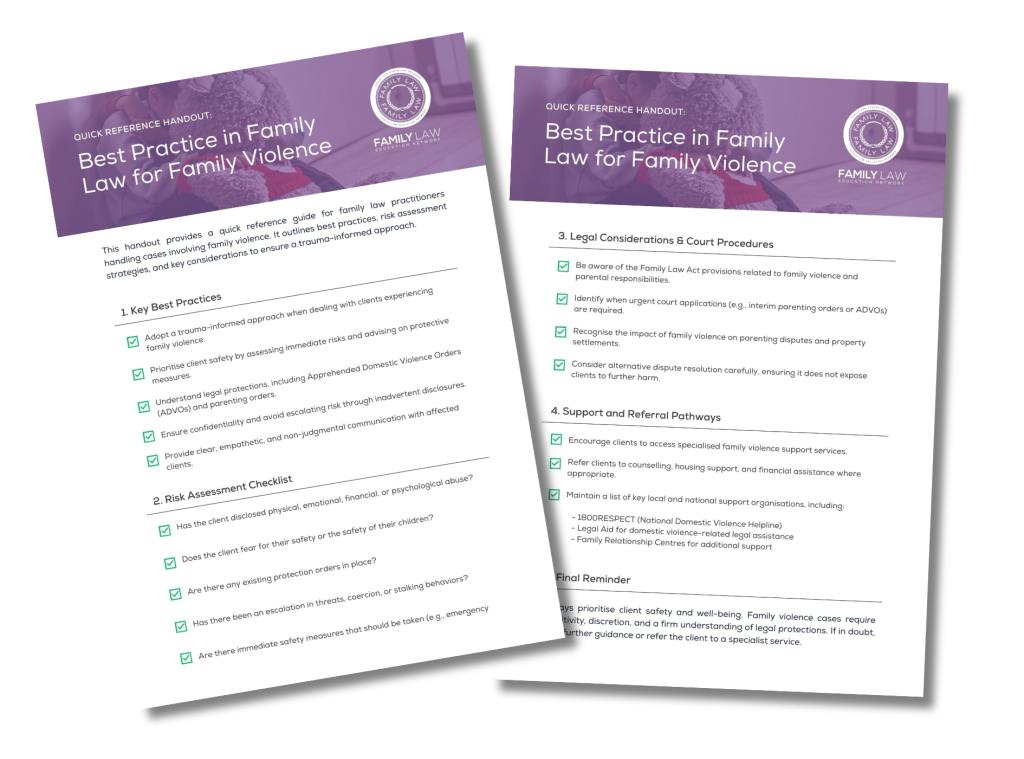
Download our free Quick Reference Handout: Best Practice in Family Law for Family Violence HERE