



Family Law Education Network

The Calm in the Storm

How Family Lawyers Can Support Child Wellbeing During Parental Disputes

Written by Rachel Brace

Photography provided by Rachel Brace

When families have to reorganise themselves following parental separation, children often find themselves caught in the emotional crossfire. Parental separation and disputes about what happens to the family home and ‘time spent’ arrangements are, understandably, periods of heightened stress and uncertainty for both adults and children. However, amidst the storm, family lawyers hold a unique and powerful position – one that can help to calm the chaos, reduce the intensity of conflict, and support outcomes that promote a child’s long-term wellbeing.

It is often said that children are resilient. This is true, but it comes with a caveat: resilience blossoms in environments where children feel safe, seen, heard, have positive relationships with parents and are largely shielded from adult problems. In contrast, exposure to family violence, high levels of parental conflict and ongoing disputes about parenting schedules compromise a child’s emotional and psychological development.

Against this backdrop, family lawyers – who are often engaged in the period following separation when parents are unable to reach agreement – are not just legal representatives; they are influential figures who help set the emotional and procedural tone of the separation process. The way they engage with their own clients, the other parent, that parent’s legal representative, and the broader legal system can significantly shape how both parents and children experience both the separation and its aftermath. Their approach can also influence the development of a cooperative parental alliance, something children need their mums and dads to build, not as former partners, but as parents.


“Family lawyers hold a powerful position — one that can calm chaos, reduce conflict, and support outcomes that protect a child’s long-term wellbeing.”

The Human Element of Divorce.

From my 18 years’ experience as a family consultant, Reg 7 Report Writer and Single Expert Witness, family law is not simply about affidavits, property settlements and parenting orders. At its heart, it is about people, children and families. It’s about navigating the complexities of grief, loss, disappointment, anger, hurt and unavoidable change. While legal expertise is vital, the ability to support clients through emotional upheaval with empathy and care ultimately serves the children at the centre.

Family lawyers who approach their work through a family-centred lens recognise that every decision, every negotiation, and every conversation, email or letter has the potential to either reduce or escalate conflict. This means showing up not only as legal advocates but also as empathetic professionals who model how to handle both difficult conversations and big emotions with calm, compassion, and respect.

In negotiations, hearings or strategy meetings, when a family law professional speaks with empathy, listens without judgment, and communicates clearly and calmly, they are not only helping their client feel heard and supported, they are setting the tone for how that client may go on to engage with the other parent. In other words, a lawyer’s example can ripple outward into the wider family system.

“A lawyer can be firm and tough-minded while being unfailingly courteous. Indeed, there is real power that comes from maintaining one’s dignity in the face of a tantrum, from returning courtesy for rudeness, from treating people respectfully who do not deserve respect and from refusing in kind to personal insult.”

-Lander v Council of the Law Society of the Australian Capital Territory [2009] ACTSC 117, [24]

Language Matters.

In family law, the words we use matter. Greatly.

Language can either pour fuel on the fire or help extinguish the flames. Adversarial phrasing such as “fighting for custody,” “custody battle” “dispute”, “win”, “lose” or “battle over access”, tends to reinforce a combative mindset. These word positions parents as the opposition and/or enemies and children as the prize. Not only is this deeply unhelpful, but it also undermines the post separation relationship children need their parents to establish to feel safe and secure in both homes.

Lawyers who adopt family-friendly language do more than soften the tone of legal proceedings – they can turn their clients mindset toward one that is cooperative and child-focused. Terms such as “co-parenting arrangements,”, “shared responsibilities,” and “when they are in their other home” (rather than “visit”) encourage parents to view the post-separation family as a new structure rather than a broken one. This reframing also encourages parents to see one another not as adversaries, but as collaborative contributors to their child’s life – a shared investment rather than a competition.

Even subtle language choices both in conversations with the client and other legal representatives can make a meaningful difference. Referring to the other party as “the mother,” “the father,” or “your co-parent,” and using terms like “parenting/family time” instead of “supervised access” or “contact,” can help keep the focus on what truly matters: the child’s ongoing relationship with both parents and a shift toward a businesslike parental relationship. Encouraging parents to use the phrase “our child” instead of “my child” can also gently foster a sense of shared responsibility and help avoid a zero-sum mindset.

“Language in family law matters. The words we choose can either deepen divides or create space for understanding.”

Conflict as an Opportunity for Growth.

Conflict is not inherently negative. it is how it is approached and managed that determines whether it becomes harmful or constructive. In the context of separation and family breakdown, conflict can offer an opportunity for growth, reflection, and skill-building. Family lawyers are well-placed to support this shift by helping clients challenge unhelpful thinking patterns such as emotional reasoning, black-and-white thinking, personalization and blaming, extreme thinking and assumptions about the other parent’s thoughts or intentions. By reframing conflict as a chance to improve communication and develop a more functional co-parenting dynamic, lawyers can help clients move from adversarial thinking toward collaborative problem-solving. This does not involve minimising distress, ignoring safety issues or assuming that all separations will be amicable. Rather, it involves supporting clients to engage with conflict constructively, in ways that prioritise their children’s wellbeing and support long-term relational health and safety for all family members.

Encouraging clients to consider their children’s perspective can also be a powerful tool. Questions like, “How might your child feel hearing about this disagreement?” or “What kind of example do you want to set for your child in how you handle this situation?” can be gentle yet effective in shifting focus from blame to responsibility.

Another useful prompt “how much will this particular issue matter to you in two weeks, six months, or five years from now?” can help clients gain perspective, assess the long-term importance of an issue, and decide whether it is truly worth the emotional, financial and relational cost of further conflict and litigation.

Lawyers can also model constructive conflict resolution by:

  • Staying calm and composed even when clients are not.
  • Acknowledging and validating emotions while guiding toward practical steps.
  • Encouraging mediation and other collaborative processes.
  • Avoiding inflammatory statements in correspondence or court documents.
  • Emphasising the shared goal of child wellbeing.
  • Avoiding unnecessary or excessive legal correspondence and refraining from sending communications that demand a response late on a Friday afternoon, recognising the emotional impact and potential to escalate tension over weekends.

In doing these things, lawyers invite their clients to mirror these behaviours – reminding us that even small shifts in how a parent approaches conflict and disagreement can create meaningful momentum toward a healthier, more cooperative relationship ultimately for the benefit of their children.

The Power of Collaboration.

While family law has traditionally been adversarial in structure, more and more lawyers are embracing collaborative approaches. These are not only less emotionally taxing, but also more child-friendly.

Collaborative practice involves both parents and their respective lawyers committing to resolve disputes without court, through a series of structured discussions. Other professionals, such as psychologists, financial advisors, or child consultants, may also be included to provide support and guidance.

This model encourages transparency, cooperation, and long-term thinking. Rather than focusing on who is “right” or “wrong,” the emphasis is placed on what arrangements will work best for the child’s needs and development.

Family lawyers who practise collaboratively:

  • Encourage clients to focus on interests rather than positions.
  • Promote openness rather than secrecy.
  • Demonstrate respect for the other party and their counsel (even when they disagree).
  • Prioritise solutions that serve the family as a whole, not just the individual client.

Such lawyers show that it is possible to advocate without attacking, to negotiate without threats, and to resolve disputes in ways that preserve both dignity and relationships. This is especially important given that, regardless of the outcome at Court, parents who share children will need to continue interacting for many years to come.

Spending years entrenched in litigation, reading affidavits that highlight your worst moments, revisiting painful relationship history, and defending your parenting in writing does little to foster the trust and cooperation needed to co-parent effectively once the legal dust has settled.

Supporting Children by Supporting Parents.

It is easy to say we want to act in “the best interests of the child.” But what does that really mean in practice?

Children tend to do best when their parents are able to maintain consistent and responsive caregiving, even while navigating the emotional challenges of separation. Strong and positive parent-child relationships are particularly protective, especially when each parent can support and respect their child’s relationship with the other parent, even if their personal feelings toward that person are complex or strained.

Supporting children in this way begins with ensuring that parents are well-informed, empowered, and guided to place their children’s needs above their own personal grievances. When parents are supported to prioritise their child’s wellbeing, they are more likely to adopt approaches that promote stability and reduce emotional distress.

Family lawyers can play a vital role here by:

  • Providing clear, accurate information to reduce confusion and anxiety.
  • Providing clients with realistic, practical advice about legal processes and likely outcomes, helping to manage expectations and support informed decision-making
  • Referring clients to counsellors, parenting courses, or parenting coordinator when appropriate.
  • Encouraging the use of a post separation parenting app to communicate and share important parenting information if/when phone calls or face to face conversations prove too difficult.
  • Encouraging respectful co-parenting practices, even when relationships are strained.
  • Helping clients create structured, predictable parenting arrangements that allow children to feel secure.

By encouraging parents to develop a business-like relationship, that supports them to effectively manage conflict, establish consistent routines across households, and share resources, rights, and responsibilities, lawyers indirectly support children to feel loved, safe, and free to enjoy relationships with both parents.

A Final Word: Walking the Talk.

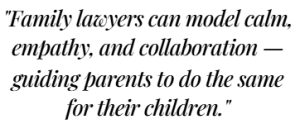
Children learn how to manage conflict, regulate emotions, and respond to life’s challenges by observing the adults around them. If we want children to develop into respectful, emotionally intelligent, and resilient individuals, those of us working with parents and families – especially in the legal space – must be prepared to model these attributes ourselves.

By using language that de-escalates, encourages problem-solving over point-scoring, guides clients toward emotionally intelligent responses to disagreements and promotes compromise and cooperation where possible, lawyers can help shift the tone of a difficult separation toward one that supports child and family wellbeing.

This is not about being idealistic. It is about setting a standard for professional conduct that prioritises outcomes for children and demonstrates to parents that there is a constructive path forward.

To my mind, supporting parents to better support their children may not always be straightforward, but in family law, it is some of the most important and rewarding work we do.